

Securing a position as an Assistant Chemist Trainee (ACT) with NTPC Limited is a prestigious career milestone for chemistry postgraduates. However, candidates often face a significant hurdle when searching for an official NTPC ACT previous year paper. It is critical to state clearly that NTPC Limited does not release official archives of past question papers for public download.
Serious aspirants must rely on memory-based papers, unofficial model sets, and expert-curated mock tests to understand the exam’s nuances. These resources, while unofficial, provide the only window into the “Moderate” difficulty typical of NTPC technical assessments. Unlike research-heavy exams like CSIR-NET or GATE, the NTPC ACT exam is specifically designed at the PGT (Post Graduate Teacher) or First Grade level.
This guide serves as a comprehensive roadmap for utilizing these alternative resources effectively for the 2026 recruitment cycle. By focusing on the official syllabus and professional practice sets, you can bridge the gap left by the absence of official archives. This approach ensures you are prepared for the unique technical demands of India’s largest power utility.
NTPC ACT Previous Year Paper Overview
The following table provides a quick snapshot of the examination and the current status of available resources for the Assistant Chemist Trainee position under Advertisement No. 09/26.
| Feature | Details |
| Exam Name | NTPC Assistant Chemist Trainee Selection Test |
| Conducting Body | NTPC Limited |
| Post | Assistant Chemist Trainee (ACT) |
| Paper Type | Objective (Multiple Choice Questions) |
| Available Years | Memory-based collections from 2018-2024 |
| PDF Status | Memory-based/Model papers only |
| Authenticity | Unofficial (Based on candidate memory and expert synthesis) |
| Answer Key Availability | Available for Mock and Model sets only |
NTPC ACT Question Paper PDF Download (Resource Table)
Since official archives do not exist, we have organized the following practice resources based on historical patterns and current syllabus requirements. These sets are designed to mimic the difficulty level of the E0 grade entry test.
| Year | Resource Name | Paper Category | Answer Key | Source Status |
| 2026/2025 | NTPC ACT Comprehensive Mock Set 1 | Model Paper | Yes | [Download Practice Set] |
| 2026/2025 | NTPC ACT Comprehensive Mock Set 2 | Model Paper | Yes | [Download Practice Set] |
| 2024 | Memory-Based Paper Compilation | Unofficial | Yes | [Download Practice Set] |
| 2023 | Industry-Standard Model Question Bank | Model Paper | Yes | [Download Practice Set] |
| 2022 | General PSU Chemist Practice Set | Mixed PSU | Yes | [Download Practice Set] |
Important Note: Resources for 2026 and 2025 are not officially available from the organization. Candidates should prioritize model papers designed around the 150-question format established in the latest notification.
Are NTPC ACT Previous Papers Officially Available?
Directly speaking, no official public archive of previous year papers is provided by NTPC. While the organization maintains an official syllabus and publishes recruitment notifications (Advt. No. 09/26), it keeps actual question booklets confidential. Candidates are strongly advised to exercise caution against websites claiming to offer “Official NTPC Question Paper PDFs,” as these are almost always unofficial reconstructions.
NTPC Official Notification Check
Understanding the Difference: Types of Exam Papers
To prepare effectively, you must understand the nature of the materials you encounter during your search. A senior consultant’s perspective helps in identifying which documents offer the most value for your time.
- Official Question Paper: These are the actual papers used during the exam, which are rarely available for the NTPC ACT due to strict non-disclosure policies.
- Candidate Response Sheet: This is a personal copy showing a candidate’s selected answers, released briefly for objection windows. These are valuable because they provide the exact wording of questions that memory-based sets often summarize.
- Memory-based Paper: Compiled by educators based on specific questions remembered and reported by candidates immediately after the exam session. These offer a genuine sense of the “PGT-level” difficulty and topics frequently favored by NTPC.
- Model Paper/Mock Test: Original sets created by experts that mimic the official syllabus and question distribution. These are essential for timed simulations.
- General PSU Chemist Paper: Papers from exams like IOCL, ONGC, or GAIL. These are useful because the chemistry syllabus for “Assistant Chemist” roles is standardized across the energy sector.
NTPC ACT 2026 Exam Pattern & Selection Process
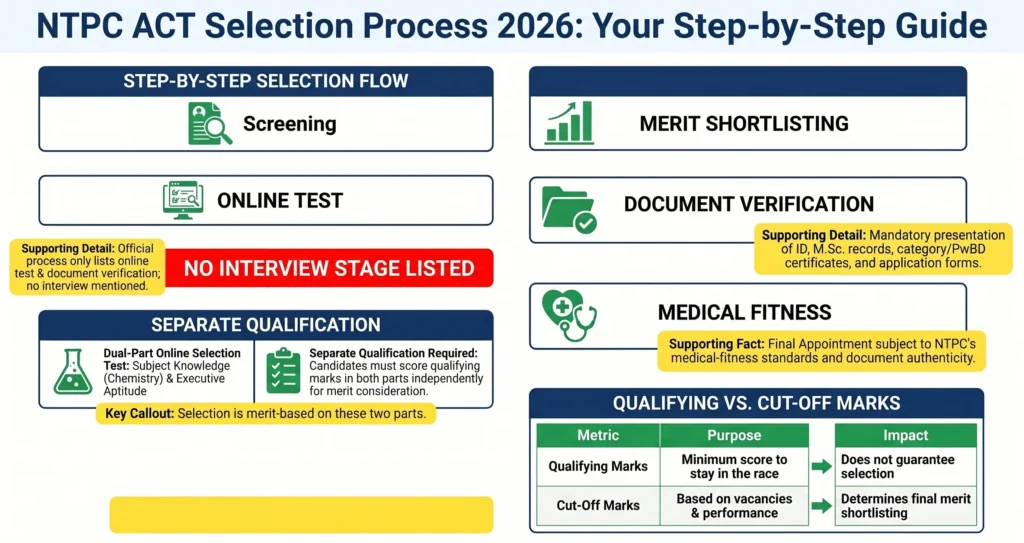
The selection process for the 40 vacancies announced under Advertisement No. 09/26 is rigorous and merit-based. It ensures that only those with strong technical foundations are inducted into the E0 Grade (₹30,000 – ₹1,20,000).
Selection Stages:
- Online Selection Test: A computer-based assessment divided into two parts that must be cleared separately.
- Document Verification: Shortlisted candidates must present original M.Sc. marksheets and category certificates.
- Medical Examination: Conducted by the NTPC Medical Board to determine if the candidate meets strict medical fitness standards.
Test Components: The exam features a total of 150 questions to be completed in a single 2-hour window. Accuracy is vital due to the negative marking scheme.
| Subject | Number of Questions | Marks | Duration | Negative Marking |
| Part 1: Subject Knowledge (Chemistry) | 120 | 120 | 2 Hours (Total) | 1/4 Mark |
| Part 2: Executive Aptitude | 30 | 30 | 2 Hours (Total) | 1/4 Mark |
| Total | 150 | 150 |
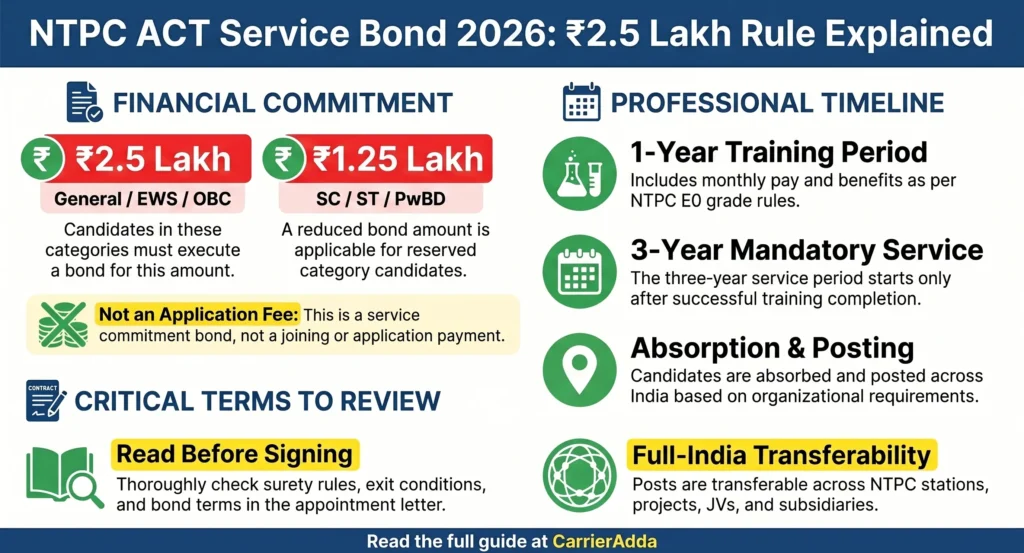
Service Bond and Training: Selected candidates will undergo one year of specialized training at various locations. Upon successful completion, candidates are required to serve the company for at least 3 years. The service bond amount is ₹2,50,000 for General/EWS/OBC and ₹1,25,000 for SC/ST/PwBD categories.
Important Topics for Chemistry Practice (Syllabus-Based)
Your preparation should be anchored in the official “Indicative Syllabus.” A key insight from past recruitment cycles is that NTPC requires a “Moderate” level of depth—think PGT or First Grade level rather than the research-intensive GATE or NET standards.
Physical Chemistry (The Foundation): Success begins with General Physical Chemistry (GPC), which acts as the prerequisite for all other sections. You must master the Mole Concept, Stoichiometry, and Redox Reactions before moving to complex modules.
- Atomic Structure and Quantum Mechanics.
- Chemical Thermodynamics, Energetics, and Phase Equilibria.
- Chemical Kinetics, Catalysis, and Surface Chemistry.
- Electrochemistry, Ionic Equilibrium, and States of Matter.
Organic Chemistry: NTPC emphasizes systematic understanding over rote memorization of reactions. Focus on the underlying mechanisms and electronic effects.
- GOC (General Organic Chemistry) and Stereochemistry.
- Reaction Mechanisms: Alkanes, Alkenes, Alkynes, and Benzene.
- Carbonyl Chemistry: Aldehydes, Ketones, and Carboxylic Acids.
- Spectroscopy: IR, UV-Visible, and NMR applications for structure determination.
- Polymers, Biomolecules, and Environmental Chemistry.
Inorganic Chemistry:
- Chemical Bonding and Periodicity.
- Coordination Compounds and Organometallics.
- Main Group Elements (s-block and p-block) and Transition Elements.
- Bio-Inorganic Chemistry and Metallurgy basics.
Analytical Chemistry & Instrumental Methods (Industry Specific): This section is crucial as the role of an Assistant Chemist involves power plant water chemistry and quality control.
- Principles of Volumetric, Gravimetric, and Chromatographic Analysis.
- Instrumental methods (HPLC, GC) used for industrial monitoring.
Executive Aptitude (The Tie-Breaker): Do not ignore these 30 marks, as they often decide the final merit list.
- Vocabulary & Reading Comprehension: Focus on professional English and technical reporting terms.
- Quantitative Aptitude: Data Interpretation (DI) is particularly important for analyzing plant data.
- Logical Reasoning: Practicing daily with PGT-level reasoning sets is recommended.
NTPC ACT Practice Questions (Original Mock Set)
Note: This set is based on the “Moderate/PGT” difficulty level highlighted in recruitment trends.
Q1. In the IR spectrum, the carbonyl stretching frequency of an aldehyde typically appears at: A) 1720–1740 cm^{-1} B) 1650–1680 cm^{-1} C) 3300–3500 cm^{-1} D) 2100–2250 cm^{-1} Correct Answer: A Explanation: Carbonyl groups in aldehydes and ketones show a very strong, distinct absorption in the 1700–1750 cm^{-1} range.
Q2. The half-life period of a first-order reaction is 69.3 seconds. What is its rate constant? A) 0.01 s^{-1} B) 0.1 s^{-1} C) 0.001 s^{-1} D) 1.0 s^{-1} Correct Answer: A Explanation: Using the formula k = 0.693 / t_{1/2}, we find k = 0.693 / 69.3 = 0.01 s^{-1}.
Q3. Which transition metal ion shows the highest magnetic moment? A) Cu^{2+} B) Ni^{2+} C) Fe^{3+} D) Co^{2+} Correct Answer: C Explanation: Fe^{3+} is a d^5 system with 5 unpaired electrons, the maximum possible for these options, resulting in the highest spin-only magnetic moment.
Q4. The monomer of Natural Rubber is: A) Neoprene B) Isoprene C) Styrene D) Vinyl Chloride Correct Answer: B Explanation: Natural rubber is chemically identified as polyisoprene, a polymer of 2-methyl-1,3-butadiene.
Q5. The coordination number of Cobalt in [Co(en)_3]Cl_3 is: A) 3 B) 4 C) 6 D) 9 Correct Answer: C Explanation: Ethylenediamine (en) is a bidentate ligand. Three bidentate ligands occupy 6 coordination sites (3 x 2).
Q6. Which type of chromatography is standard for separating non-volatile organic compounds in industrial labs? A) Gas Chromatography B) HPLC C) Paper Chromatography D) Thin Layer Chromatography Correct Answer: B Explanation: High-Performance Liquid Chromatography (HPLC) is the preferred instrumental method for non-volatile or thermally unstable compounds.
Q7. Which gas is the primary contributor to the Greenhouse Effect? A) Nitrogen B) Oxygen C) Carbon Dioxide D) Argon Correct Answer: C Explanation: Carbon dioxide traps infrared radiation in the atmosphere, a key topic in Environmental Chemistry.
Q8. What is the hybridization of Xe in XeF_4? A) sp^3 B) dsp^2 C) sp^3d^2 D) sp^3d Correct Answer: C Explanation: XeF_4 has 4 bonding pairs and 2 lone pairs, resulting in a square planar geometry and sp^3d^2 hybridization.
Q9. The unit of molar conductivity is: A) S cm^2 mol^{-1} B) S cm^{-1} mol^{-1} C) \Omega cm^2 mol^{-1} D) S cm^2 mol Correct Answer: A Explanation: Molar conductivity represents the conducting power of all ions produced by one mole of electrolyte.
Q10. In a reversible adiabatic process, the entropy change (\Delta S) is: A) Positive B) Negative C) Zero D) Infinite Correct Answer: C Explanation: Reversible adiabatic processes are isentropic, meaning the entropy remains constant throughout the process.
Q11. The Bond Order of O_2^+ is: A) 2.0 B) 2.5 C) 3.0 D) 1.5 Correct Answer: B Explanation: Removing an electron from an antibonding \pi^* orbital increases the bond order from 2.0 (in O_2) to 2.5.
Q12. Which reagent is used in the Hinsberg test to distinguish between primary, secondary, and tertiary amines? A) Benzene sulfonyl chloride B) Nitrous acid C) Chloroform and KOH D) Methyl iodide Correct Answer: A Explanation: Primary and secondary amines react with benzene sulfonyl chloride to form sulfonamides, whereas tertiary amines do not.
Q13. Which of the following is an extensive property? A) Temperature B) Density C) Enthalpy D) Viscosity Correct Answer: C Explanation: Enthalpy depends on the amount of substance present, unlike intensive properties like density.
Q14. The number of stereoisomers possible for 2,3-dichlorobutane is: A) 2 B) 3 C) 4 D) 6 Correct Answer: B Explanation: There are 2 enantiomers (d and l) and 1 meso compound due to the internal plane of symmetry.
Q15. Which gas is used as a carrier in Gas Chromatography? A) Oxygen B) Helium C) Chlorine D) Ammonia Correct Answer: B Explanation: Inert gases like Helium or Nitrogen are used as mobile phases to carry the sample through the column.
NTPC Official Notification Check
Expert Strategy: How to Use Practice Papers Effectively
As a specialist in PSU recruitment, I suggest a strategy that moves beyond simple reading. These tips are designed to help you handle the specific “Moderate-level” pressure of the NTPC test.
- Prioritize the GPC Foundation: Before diving into high-weightage topics like Thermodynamics, ensure your General Physical Chemistry is flawless. Master mole calculations and redox balance first.
- The “Water Chemistry” Advantage: Because NTPC operates power plants, Analytical Chemistry and Instrumental Methods (Spectroscopy/HPLC) carry immense weight. Ensure you understand how these concepts apply to industrial water purification and quality monitoring.
- Simulate the 120-Minute Window: Solve full-length papers within exactly 2 hours. This trains your brain to transition quickly from complex Subject Knowledge (120 questions) to Executive Aptitude (30 questions).
- Adopt the PGT Mindset: Do not waste weeks on research-level derivation (NET/GATE style). Focus on broad conceptual clarity, reaction mechanisms, and numerical speed, which are the hallmarks of PGT-level exams.
- Master the Tie-Breaker: Dedicate 30 minutes daily to Executive Aptitude. In a competitive field of 40 vacancies, these 30 marks are often what separate the selected candidates from the rest.

NTPC ACT Mock Test Weekly Plan
A structured 4-week approach is the most effective way for M.Sc. graduates to refresh their knowledge and adapt to the 150-question format.
| Week | Focus Area | Test Type |
| Week 1 | Physical Chemistry Foundation (GPC, Thermo) | Sectional Tests |
| Week 2 | Organic Reaction Mechanisms & Stereochemistry | Sectional Tests |
| Week 3 | Inorganic & Analytical Chemistry (Industrial Focus) | Sectional Tests |
| Week 4 | Full Syllabus Revision & Aptitude Training | 3 Full-length Mock Tests |
Frequently Asked Questions (FAQs)
1. Where can I download the NTPC ACT previous year paper? NTPC does not release official past papers. Aspirants should download memory-based collections or model papers from reputable educational platforms specializing in PSU exams.
2. Are online NTPC ACT papers official? No, most papers available online are unofficial reconstructions based on candidate feedback or expert-curated sets designed to match the Advt. No. 09/26 syllabus.
3. Is a mock test the same as a previous paper? A mock test is a new set of questions designed for practice, while a memory-based “previous paper” is an attempt to recreate the exact questions that appeared in past cycles.
4. What topics appear in the chemistry test? The test covers Physical, Organic, Inorganic, and Analytical chemistry, with a significant focus on PGT-level concepts and industrial instrumental methods.
5. How many previous papers should I solve for the 2026 exam? Since official papers are unavailable, solve at least 5 memory-based sets and 10 full-length model tests to build the necessary speed.
6. Are general Assistant Chemist papers from other PSUs useful? Yes, papers from ONGC, IOCL, and GAIL are excellent resources. The technical requirements for Assistant Chemists are highly similar across the Indian energy sector.
Conclusion: Final Preparation Advice
While the lack of an official NTPC ACT previous year paper archive can be frustrating, it should not hinder your success. The official syllabus is your most reliable guide for the 2026 exam. By combining memory-based papers with high-quality mock tests and focusing on PGT-level accuracy, you can excel.
Always verify the source of any material before downloading and prioritize consistency over last-minute cramming. Follow your 4-week schedule, focus on the industrial relevance of Analytical Chemistry, and aim for a balanced performance in both sections. Best of luck on your journey to join India’s energy leader!