
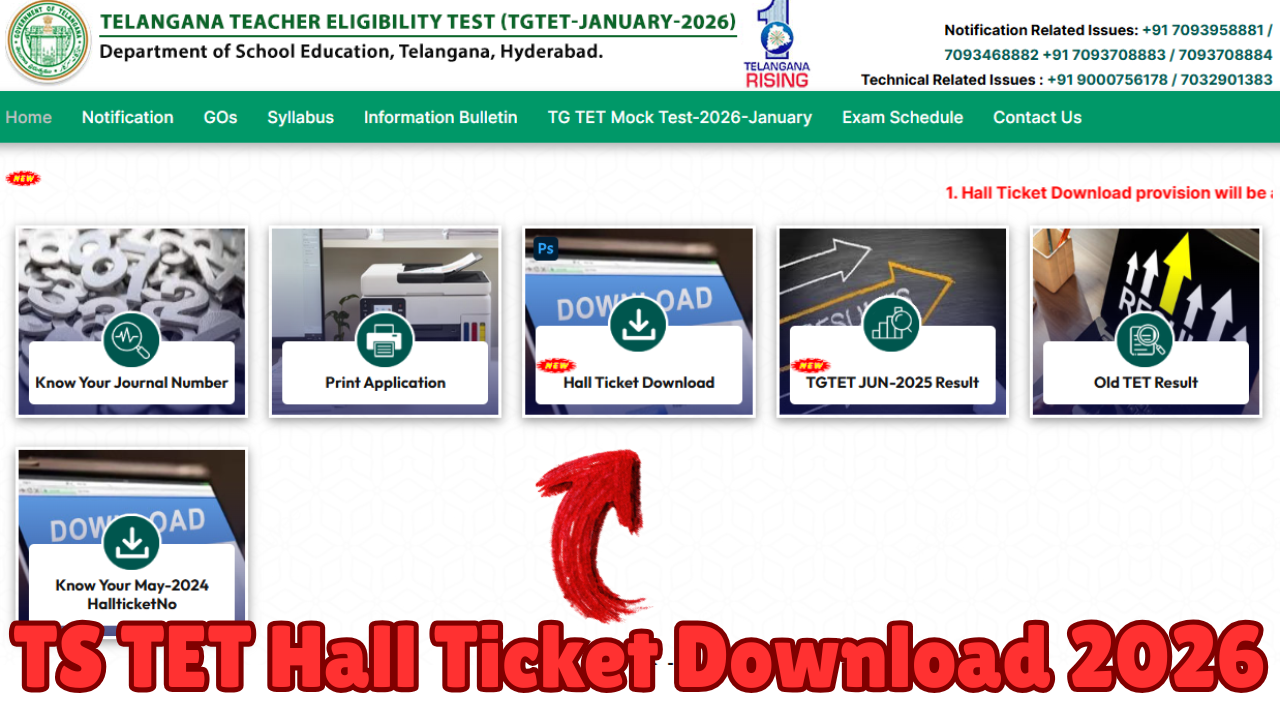
TG TET Hall Ticket Download 2026 – The Department of School Education (DSE), Government of Telangana, has officially released the hall tickets for the Telangana Teacher Eligibility Test (TGTET) January 2026 exam on December 27, 2025. This is a crucial step for every aspirant, and to help you navigate the next few weeks, we’ve created a one-stop, comprehensive guide. This post covers everything you need to know, from downloading your hall ticket and understanding the exam schedule to reviewing the syllabus, exam pattern, and expert preparation tips. The TGTET will be conducted online as a Computer-Based Test (CBT).
TGTET January 2026: Key Dates at a Glance
| Event | Date(s) |
| Hall Ticket Download Starts | December 27, 2025 |
| Exam Dates | January 3, 2026, to January 31, 2026 |
| Result Declaration | Between February 10 and 16, 2026 |
| Official Website | https://tgtet.aptonline.in/tgtet/ |
Downloading Your TG TET Hall Ticket
Step-by-Step Guide to Download
Follow these simple steps to get your hall ticket:
1. Visit the official TGTET website: https://tgtet.aptonline.in/tgtet/.
2. Click on the link that reads “Hall Ticket Download.
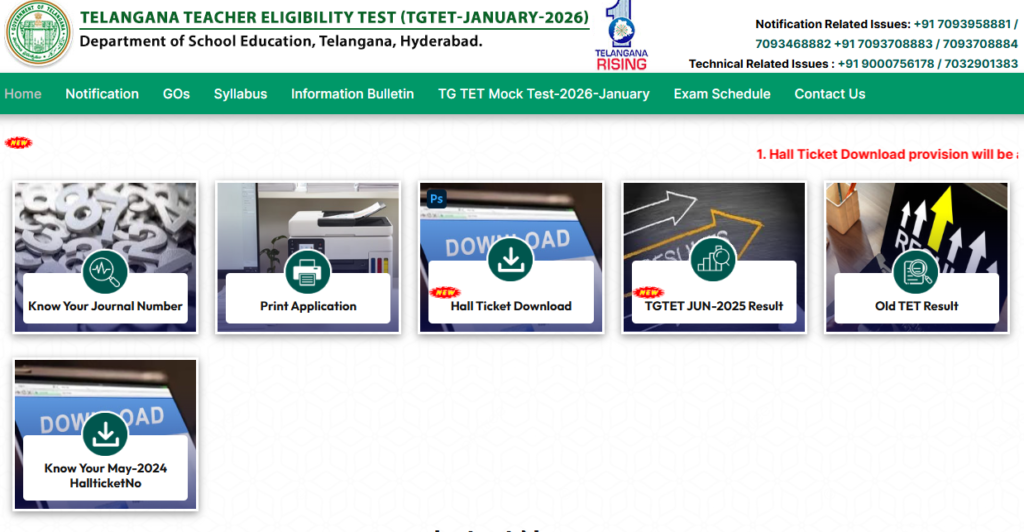
3. On the new login page, enter your Journal Number (or Candidate ID/Registered Mobile Number) and Date of Birth.
4. Click on “Proceed” to view your hall ticket.
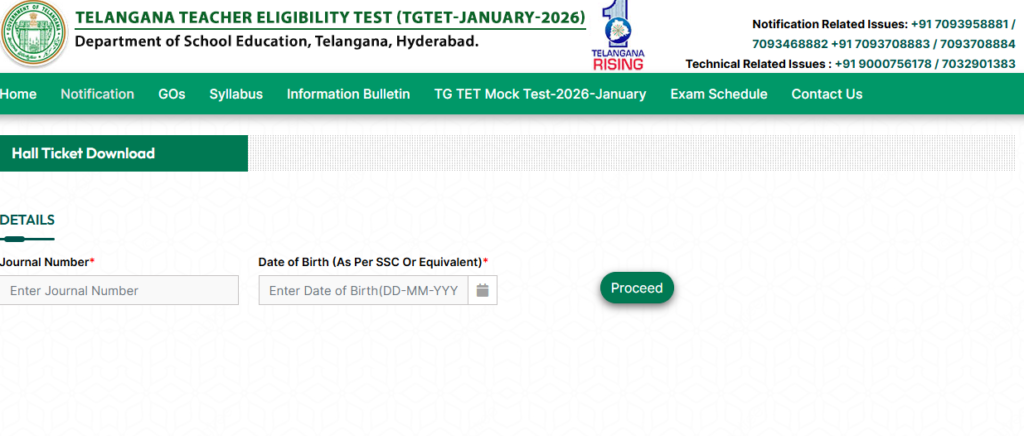
5. Download the PDF and print a clear copy on A4-sized paper.
Note: It is recommended to use a desktop computer for downloading the hall ticket to avoid any potential discrepancies.
Important: Verify Your Hall Ticket Details
Once downloaded, it is critical to immediately and carefully verify every detail on your hall ticket. Any discrepancy could prevent you from taking the exam.
• Candidate’s name and personal details
• Registration and roll number
• Exam date, time, and shift
• Exam centre name and address
• Exam day instructions
Facing Issues? Here’s What to Do
If you are unable to download your hall ticket or find any errors in the details, you must contact the Director, SCERT & Ex officio Director, TET, Hyderabad. The contact window is from 10:30 am to 5:00 pm on all working days.
| Issue Type | Contact Number(s) |
| Technical Issues | 9000756178 / 7032901383 |
| Notification Issues | 7093958881 / 7093468882 |
| TG-TET Office | 7093708883 / 7093708884 |
TG TET January 2026 Exam Schedule and Timings
The TGTET exam will be conducted across multiple days in two shifts.
• Shift 1: 9:00 AM to 11:30 AM
• Shift 2: 2:00 PM to 4:30 PM
| Exam Date | Shift | Paper & Subjects |
| 3rd January 2026 | Shift 1 & 2 | Paper-II (Mathematics & Science) |
| 4th January 2026 | Shift 1 & 2 | Paper-II (Mathematics & Science) |
| 5th January 2026 | Shift 1 & 2 | Paper-II (Social Studies) |
| 6th January 2026 | Shift 1 & 2 | Paper-II (Social Studies) |
| 8th January 2026 | Shift 1 & 2 | Paper-I |
| 9th January 2026 | Shift 1 | Paper-I |
| 11th January 2026 | Shift 1 & 2 | Paper-I |
| 19th January 2026 | Shift 1 | Paper-I (Minor) |
| 20th January 2026 | Shift 1 | Paper-II (Minor) Mathematics-Science & Social Studies |
Note: ‘Minor’ papers typically refer to less common language options selected by candidates during registration. Please verify the exact subject on your personal hall ticket.
Exam Day Essentials
Documents You MUST Carry
Be sure to bring the following mandatory items to the examination center:
1. Printed TG TET Hall Ticket 2026: A clear, printed copy on A4-sized paper.
2. Original Photo ID Proof: A valid government-issued ID such as an Aadhaar Card, Voter ID, Passport, Driving License, or PAN Card.
3. Passport-sized Photographs: Carry at least two recent photographs for the verification process.
Prohibited Items
The following items are strictly forbidden inside the examination hall:
• Mobile phones
• Any electronic gadgets
• Digital or soft copies of the hall ticket on phones or tablets are NOT permitted for entry. You must have a physical printed copy.
Understanding the TG TET Exam Pattern
The TGTET consists of two papers: Paper-I for aspirants who wish to teach Classes 1-5, and Paper-II for those aiming to teach Classes 6-8. Candidates who intend to teach all classes from 1 to 8 must appear for both papers.
Both papers share a common structure: 150 objective-type questions for a total of 150 marks, with a duration of 2.5 hours. A key advantage for candidates is that there is no negative marking for incorrect answers.
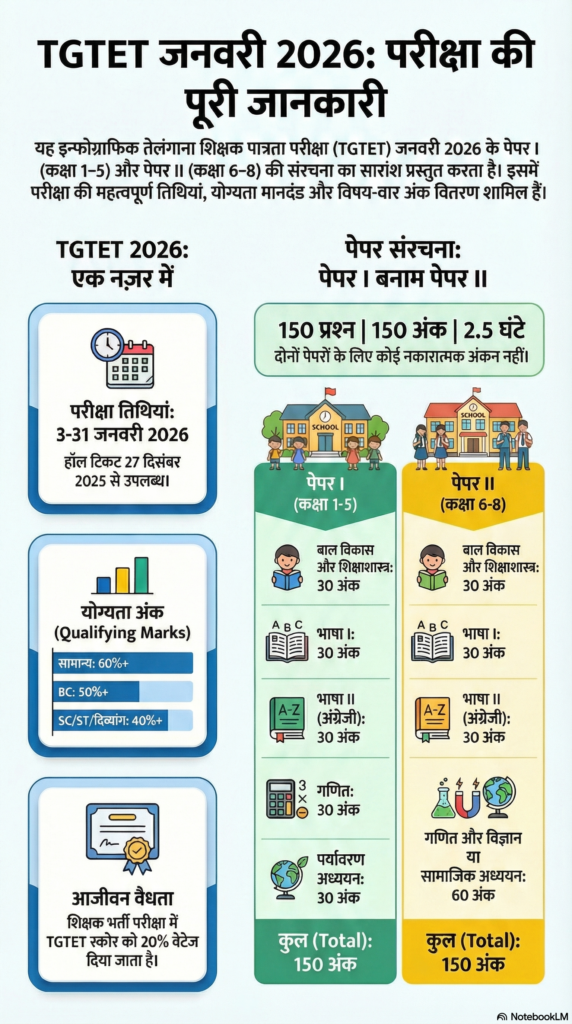
Paper-I Exam Pattern
| Subjects | No. of Questions | Marks |
| Child Development & Pedagogy | 30 | 30 |
| Language I | 30 | 30 |
| Language II – English | 30 | 30 |
| Mathematics | 30 | 30 |
| Environmental Studies | 30 | 30 |
| Total | 150 | 150 |
Paper-II Exam Pattern
| Subjects | No. of Questions | Marks |
| Child Development & Pedagogy | 30 | 30 |
| Language I | 30 | 30 |
| Language II – English | 30 | 30 |
| Subject-Related Questions | 60 | 60 |
| Total | 150 | 150 |
Note: For Paper-II, the “Subject-Related Questions” section is for candidates to choose between (a) Mathematics & Science or (b) Social Studies.
TGTET Syllabus Overview
This is a high-level summary of the main syllabus topics. For a complete and detailed breakdown, all candidates should refer to the official notification.
Note: Language I is a choice made by the candidate during the application. The languages listed here (Telugu for Paper I, Marathi for II) are examples from the official syllabus. Your specific Language I paper will be listed on your hall ticket.
Paper I
• I. Child Development and Pedagogy (Marks: 30)
◦ Development of Child (Growth, Maturation, Principles of Development, Factors, Dimensions, Theories)
◦ Individual Differences (Attitudes, Aptitude, Interest, Intelligence)
◦ Personality Development and Adjustment
◦ Understanding Learning (Concept, Factors, Approaches like Behaviourism, Constructivism, Gestalt)
◦ Pedagogical Concerns (Teaching methods, Classroom Management, CCE, NCF 2005, RTE Act 2009)
• II. Language I – Telugu (Marks: 30)
◦ Reading Comprehension (Poetry, Prose)
◦ Telangana Literature and Culture
◦ Vocabulary (Proverbs, Idioms, Synonyms, Antonyms)
◦ Elements of Language (Grammar, Punctuation, Sentence types, etc.)
◦ Teaching Methodology
• III. Language II – English (Marks: 30)
◦ Parts of Speech, Tenses, Types of Sentences, Prepositions & Articles
◦ Direct/Indirect Speech, Active/Passive Voice, Degrees of Comparison
◦ Reading Comprehension and Vocabulary (Idioms, Synonyms, Antonyms)
◦ Composition and Sentence Correction
◦ Pedagogy (Aspects of English, Objectives, Phonetics, Language Skills)
• IV. Mathematics (Marks: 30)
◦ Number System (Natural Numbers, Integers, Rational Numbers, Primes)
◦ Fractions (Proper, Improper, Mixed, Decimal)
◦ Arithmetic (Unitary method, percentages, profit & loss, ratio, interest)
◦ Geometry (2D & 3D shapes, angles, triangles, quadrilaterals, circles)
◦ Measurements (Length, Weight, Capacity, Area, Volume)
◦ Data Applications (Bar Graph, Pictograph, Mean, Median, Mode)
◦ Algebra (Simple equations, exponents, algebraic expressions)
• V. Environmental Studies (Marks: 30)
◦ My Family, Work & Play, Plants and Animals, Our Food
◦ Shelter, Air, Energy, Water
◦ Our Body – Health – Cleanliness, Sense Organs
◦ Mapping (Directions, State, India)
◦ History and Culture of India
◦ Our State (Telangana) and Our Country (India)
◦ Indian Constitution and Security (Disaster Management)
Paper II
• I. Child Development and Pedagogy (Marks: 30)
◦ (Syllabus is identical to Paper I)
• II. Language I – Marathi (Marks: 30)
◦ Content (Comprehension, Poetry, Grammar, Vocabulary)
◦ Methodology (Language principles, teaching methods, planning, evaluation)
• III. Language II – English (Marks: 30)
◦ (Syllabus is identical to Paper I)
• IV(a). Mathematics & Science (Marks: 60)
◦ Mathematics (Content):
▪ Number System (Prime, Composite, Real numbers, Euclid division lemma, logarithms)
▪ Arithmetic (Ratio, interest, time & distance, profit & loss)
▪ Sets (Concept, operations, Venn diagrams)
▪ Algebra (Expressions, linear & quadratic equations, progressions)
▪ Geometry (Euclid Geometry, Triangles, Circles, Co-ordinate Geometry)
▪ Mensuration (Area & Volume of Cube, Cuboid, Cylinder, Cone, Sphere)
▪ Data Handling (Mean, median, mode, probability)
▪ Trigonometry (Ratios, identities, applications)
◦ Science (Content):
▪ Natural Resources (Air, Water), Our Universe (Solar system, stars)
▪ Natural Phenomenon (Light, Sound, Heat)
▪ Mechanics (Motion, Newton’s Laws, Work & Energy)
▪ Magnetism and Electricity
▪ Matter around us (Acids, bases, salts, metals, non-metals)
▪ Atomic Structure, Periodic Classification, Chemical Bonding
▪ Metallurgy
▪ Biology (Living World, Cell, Tissues, Plant World, Animal World)
▪ Microbes, Our Environment, Recent Trends in Biology
• IV(b). Social Studies (Marks: 60)
◦ Diversity on the Earth (Maps, Globe, Climate, Geography of India & Telangana)
◦ Production – Exchange and Livelihoods (Agriculture, Industries, Money & Banking, Globalization)
◦ Political Systems and Governance (Local Govt, Empires, National Movement, Indian Constitution)
◦ Social Organization and Inequities (Gender, Caste, Poverty, Human Rights)
◦ Religion and Society (Ancient religions, reform movements, Secularism)
◦ Culture and Communication (Language, Sculpture, Buildings, Media, Sports)
Qualifying Marks and Certificate Validity
To pass the TGTET, candidates must achieve the minimum qualifying marks set for their category.
• General: 60% and above
• BC: 50% and above
• SC/ST/Differently-abled (PH): 40% and above
Keep these two important points in mind about your TGTET qualification:
• Certificate Validity: The TGTET qualifying certificate is valid for a lifetime.
• Score Weightage: The TGTET score carries 20% weightage in the state’s Teacher Recruitment Test (TRT), making a high score valuable for future recruitment.
Expert Tips for TG TET Aspirants
In an interview with SocialPost EduHub, Nani Yadav, Founder of Sunrise Academy, shared several valuable tips for candidates preparing for competitive exams like TG TET.
• Long-Term Preparation is Key: Success is built over time. Begin your preparation well before the official notification is released. Avoid relying on short-term, 2-3 month crash courses.
• Master the Syllabus, Then Revise: Complete your study of the entire syllabus first, whether through coaching or self-study. Use the period after the notification is released for focused revision and writing weekly topic-based exams.
• Intensive Practice is Crucial: The last month before the exam should be dedicated to solving as many practice papers as possible to build speed, accuracy, and confidence.
• Rest Before the Exam: In the final week, stick to revising your personal notes. Avoid taking any new practice tests and make sure to completely relax the day before the exam to ensure your mind is fresh and alert.
• Tackle Your Weak Subjects: Don’t avoid subjects you find difficult. For example, if you have a Social Studies background and struggle with Mathematics, dedicate extra time to it. Seek additional coaching, re-watch lectures, and practice consistently until you gain confidence. Use the detailed syllabus overview in Section 5 to pinpoint your specific areas of weakness and create a targeted study plan.
• Prioritize Class Notes & Academic Books: Your primary study resource should be the notes provided by your teacher, followed by official academic textbooks. Be cautious about relying solely on market publications.
Conclusion: Good Luck, Aspirants!
Your TGTET journey is well underway. The most important immediate action is to download your TG TET Hall Ticket 2026, print it, and carefully verify all the details. With your admit card in hand and a solid preparation strategy, you are set for success.
We wish you the very best for your TG TET January 2026 exam!
Other Job – India Post GDS Recruitment 2026 – 25,000 Vacancies