

The selection process for the NTPC ACT syllabus 2026 is a high-stakes gateway for chemistry professionals looking to join India’s largest integrated power utility. Under Advertisement No. 09/26, the selection test is structured into two distinct sections: the Subject Knowledge Test and the Executive Aptitude Test.
While the recruitment cycle is active for 40 vacancies, candidates must note that a separate official 2026 syllabus PDF is currently not specified in the notification. From a strategic perspective, because 2026 specific details are “To be announced,” the only way to gain a competitive edge in this recruitment is to master the official Indicative Syllabus immediately, as the core technical standards remain consistent with postgraduate requirements.
NTPC ACT Syllabus 2026 Overview
The following table summarizes the essential recruitment data for the Assistant Chemist Trainee (ACT) position.
| Feature | Details |
| Organization | NTPC Limited |
| Post | Assistant Chemist Trainee (ACT) |
| Exam Mode | Online (Computer Based Test) |
| Test Parts | Part 1 (Subject Knowledge) & Part 2 (Executive Aptitude) |
| Separate Qualification | Mandatory for both Part 1 and Part 2 |
| Exam Duration | Not specified (per Advt. 09/26) |
| Negative Marking | Not specified (per Advt. 09/26) |
| Syllabus PDF Status | Official 2026 PDF pending; Indicative Syllabus available |
| Projected Vacancies | 40 (UR-17, EWS-04, OBC-10, SC-06, ST-03) |
NTPC ACT Exam Pattern 2026
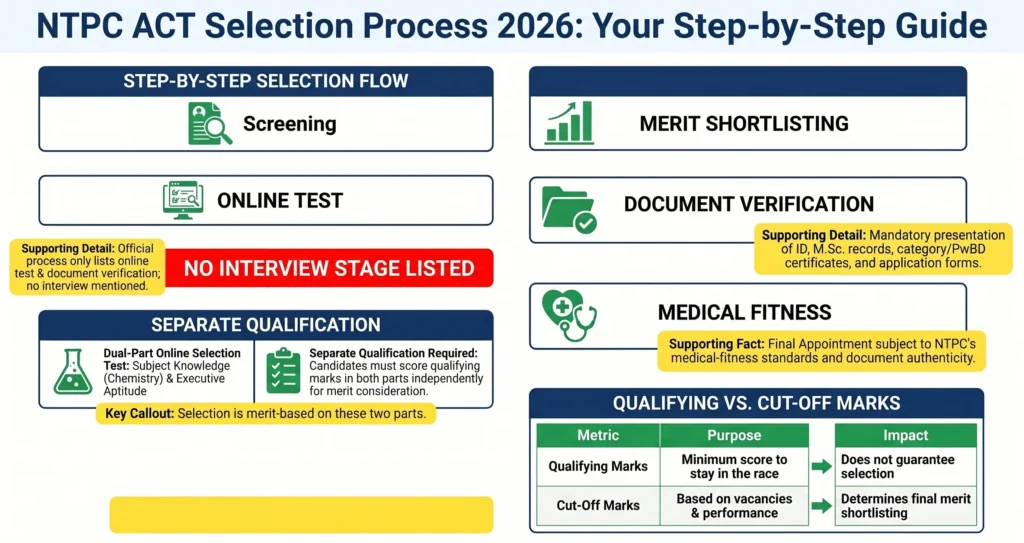
The Online Selection Test serves as the primary filter for shortlisting candidates. As an expert strategist, I cannot overstate the importance of the “separate qualification” rule: candidates are required to pass both the Subject Knowledge Test (Part 1) and the Executive Aptitude Test (Part 2) individually. Failure to meet the qualifying threshold in either section results in immediate disqualification, regardless of how high the aggregate score might be.
| Test Part | Subjects | Number of Questions | Maximum Marks | Duration | Negative Marking |
| Part 1 | Subject Knowledge (Chemistry) | Not specified | Not specified | To be announced | To be announced |
| Part 2 | Executive Aptitude | Not specified | Not specified | To be announced | To be announced |
| Total | To be announced | To be announced | To be announced | To be announced |
Strategic Note: While 2026 counts are unconfirmed, historical data indicates a typical ratio of 70 questions for Chemistry and 50 for Aptitude (120 total). However, candidates should prepare for a potentially expanded 150-question format as mentioned in recent indicative materials to ensure stamina during the CBT.
NTPC Assistant Chemist Trainee Syllabus
In the absence of a standalone 2026 document, this syllabus is constructed from official indicative topics previously released by NTPC and expert analysis of M.Sc. Chemistry and PGT-level technical requirements.
NTPC Official Notification Check
4.1 Subject Knowledge Test Syllabus (Chemistry)
The technical portion is designed for a “Moderate/PGT” level. Unlike CSIR-NET or GATE, which require extreme mathematical complexity, the NTPC ACT exam rewards conceptual clarity and systematic application.
Physical Chemistry
- Fundamental Concepts: Atomic Structure, States of Matter (Gases, Liquids, Solids).
- Thermodynamics & Kinetics: Laws of thermodynamics, enthalpy, entropy, and Chemical Kinetics (reaction rates/catalysis).
- Equilibrium & Electrochemistry: Ionic Equilibrium, Solution chemistry, Redox Reactions, and Conductance.
- Surface & Nuclear Chemistry: Adsorption, colloids, and basic Nuclear applications.
Organic Chemistry
- The Systematic Sequence: Success in this section requires following a foundational flow: General Organic Chemistry (GOC) → Isomerism → Reaction Mechanisms → Reagents.
- Reaction Intermediates: Detailed study of Carbocations, Carbanions, Free Radicals, Nitrenes, and Carbenes.
- Core Groups: Carbonyl Chemistry (Aldehydes, Ketones), alpha-beta unsaturated compounds, and Nitrogen/Oxygen-containing compounds.
- Advanced Topics: Polymers (Synthesis/Industrial use), Biomolecules (Proteins, Lipids, Carbohydrates), and Spectroscopy (Interpretive IR, UV, and NMR).
Inorganic Chemistry
- Structure & Bonding: Periodic Table trends, Chemical Bonding, and Molecular Orbital Theory.
- Elements: Coordination Compounds (Bonding and Structure), Transition Elements, Lanthanides, and S-Block/P-Block elements.
- Bio-Inorganic: Role of metals in biological systems and basic Metallurgy.
Analytical & Environmental Chemistry
- Environmental Chemistry: Pollution control, chemical safety, and atmospheric chemistry.
- Analytical Methods: Stoichiometry, Mole Concept, and basic laboratory analytical techniques.
4.2 Executive Aptitude Test Syllabus
This section assesses the general professional competency required for an E0 grade executive role.
- Vocabulary & Reading Comprehension: English grammar, synonyms, antonyms, and passage analysis.
- Quantitative Aptitude: Basic mathematical operations, percentages, and profit/loss.
- Data Interpretation: Comprehensive analysis of charts, graphs, and tables.
- Logical Reasoning: Verbal/non-verbal reasoning and pattern recognition.
- General Awareness: Current affairs, general science, and static GK.
NTPC ACT Negative Marking
A common query among candidates is the penalty for incorrect answers. While a 1/4 (0.25) negative marking rule has been the historical standard for NTPC technical exams, the official Advt. 09/26 does not explicitly confirm this rule for the 2026 cycle. This absence is a critical alert for all candidates: you must carefully read the on-screen instructions during the Computer Based Test (CBT) and verify the rules on your admit card.
NTPC ACT Syllabus PDF Download
Candidates should exclusively monitor careers.ntpc.co.in for official document releases. While there is currently no separate “2026 PDF” link, the core Chemistry topics remain consistent with M.Sc. standards. Use the “Indicative Syllabus” found in the careers section as your primary blueprint. Avoid third-party “leaked” links; all authentic updates are hosted solely on the NTPC portal.
NTPC Official Notification Check
Previous Syllabus vs. 2026 Details
| Feature | Previous/Indicative Details | 2026 Notification Details |
| Test Parts | Part 1 (Subject) + Part 2 (Aptitude) | Part 1 (Subject) + Part 2 (Aptitude) |
| Qualifying Criteria | Mandatory Separate Qualification | Mandatory Separate Qualification |
| Chemistry Topics | Core M.Sc. Standard | Core M.Sc. Standard |
| Question Weightage | 120–150 Total Questions | Not Specified |
| Negative Marking | 0.25 per wrong answer | To be confirmed in CBT |
| PDF Status | Indicative PDF Available | Official 2026 PDF Pending |
How to Prepare for NTPC ACT 2026
- Difficulty Calibration: Do not over-prepare for CSIR-NET level complexity. Focus on “Moderate/PGT” level questions. Conceptual clarity is more valuable than solving extreme GATE-level mathematics.
- Organic Strategy: Adopt the Systematic Sequence. Master General Organic Chemistry (GOC) and Reaction Intermediates before moving to specific compounds. This prevents the need for rote memorization.
- Aptitude Consistency: Dedicate 30% of your daily study time to Reasoning and Quant. Remember, a brilliant Chemistry score cannot save you if you fail to qualify in Part 2.
- Standard Resources: Stick to NCERT for basics and M.Sc. standard textbooks like O.P. Tandon (Physical/Inorganic) or Morrison & Boyd (Organic) for deeper concepts.
30-Day NTPC ACT Preparation Plan
| Period | Focus Area | Key Activities |
| Weeks 1-2 | Core Chemistry | Physical & Inorganic focus. Use NCERT + O.P. Tandon. Master Stoichiometry and Bonding. |
| Week 3 | Organic & Aptitude | Follow the Systematic Sequence (GOC/Mechanisms). Practice Daily DI and General Awareness sets. |
| Week 4 | Revision & Mocks | Solve PGT-level practice questions. Revise formula sheets. Take full-length online mock tests. |
FAQs
1. What is the NTPC ACT syllabus 2026?
The NTPC ACT syllabus 2026 consists of two parts: a Subject Knowledge Test covering M.Sc. Chemistry core topics and an Executive Aptitude Test covering Quant, Reasoning, English, and General Awareness.
2. What is the NTPC ACT exam pattern?
The exam is an online CBT. Candidates must qualify separately in Part 1 (Technical) and Part 2 (Aptitude) to be shortlisted for merit.
3. Is there negative marking?
Historically, NTPC uses a 1/4 (0.25) penalty. However, for the 2026 exam, candidates must verify the rule via the admit card or the CBT’s on-screen instructions.
4. Where can I download the syllabus PDF?
No standalone “2026 PDF” exists yet. Visit careers.ntpc.co.in and refer to the “Indicative Syllabus” provided for the Assistant Chemist Trainee recruitment.
5. Which chemistry topics should I study?
Focus on GOC, Reaction Intermediates, Thermodynamics, Coordination Compounds, Spectroscopy, and Ionic Equilibrium.
6. How should I prepare for NTPC ACT?
Balance Subject Knowledge (PGT level) with Executive Aptitude. Use M.Sc. standard textbooks and focus on conceptual clarity over extreme NET-level complexity.
Conclusion
The NTPC Assistant Chemist Trainee recruitment (Advt. No. 09/26) offers a prestigious career path for 40 qualified professionals. Success depends on navigating the dual-part test structure—Subject Knowledge and Executive Aptitude—where qualifying in both is mandatory. While the standalone 2026 syllabus PDF is pending, the indicative topics and standard M.Sc. curriculum are your best guides. Monitor the careers.ntpc.co.in portal regularly for updates on exam dates and city intimation.